

Architecture difference
TanStack Form is headless — it manages form state and validation but renders nothing itself. You own every piece of the UI. Fields are composed in JSX, types are inferred end-to-end from your schema (Zod, Valibot, Yup, or custom), and the library has zero opinion about how things look. This is ideal when you need complete control and your team is comfortable writing form logic in TypeScript. FormEngine inverts this: the form structure, field types, validation rules, and conditional logic are described in a JSON schema.FormViewer reads that schema at runtime and renders using a pluggable component adapter. The result is that forms can be stored in a database, fetched from an API, and changed without redeploying the application. The trade-off is that you define form structure in JSON rather than TypeScript — which means less type inference at authoring time but much more flexibility at runtime.
The key question is where your form definitions live. If they live in your codebase and change on a developer cadence, TanStack Form is a clean fit. If they need to live in a CMS, database, or be editable by product teams, FormEngine’s architecture is a better match.
Feature comparison
| Feature | TanStack Form | FormEngine |
|---|---|---|
| Form definition | TypeScript / JSX | JSON schema |
| Runtime schema loading (from API/DB) | Manual — requires custom wiring | Native — pass getForm callback |
| Type-safety at authoring time | Strong (full TypeScript inference) | Moderate (typed schema structure) |
| Headless / bring your own UI | Yes | Yes (pluggable view adapters) |
| MUI / Mantine integration | Manual — wrap components yourself | Native — dedicated adapters |
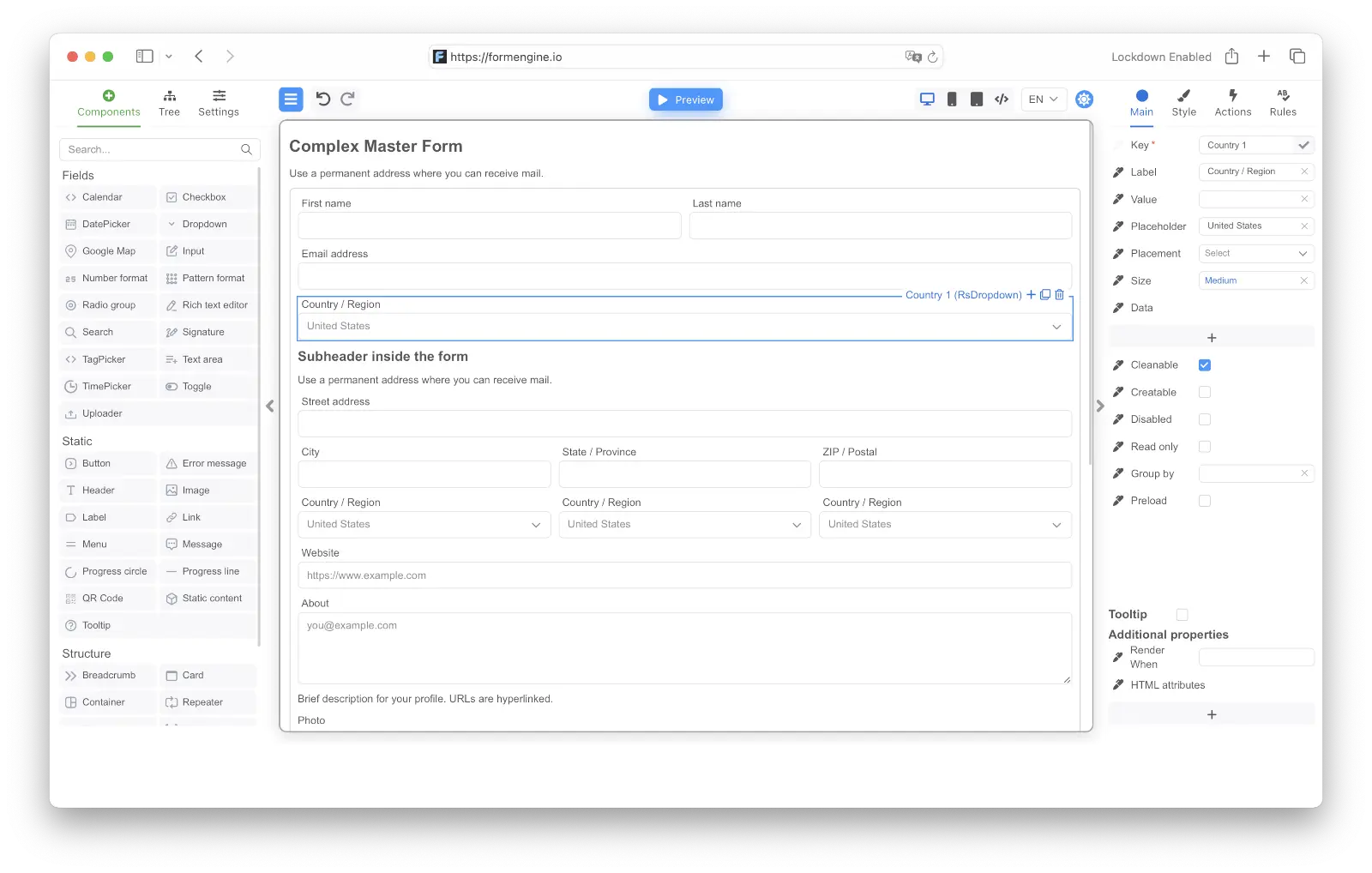
| Visual form editor for non-developers | Not included | FormEngine Designer |
| Conditional field logic | Code-based | Declarative in schema (renderWhen) |
| Computed properties | Code-based | Declarative in schema |
| Async field validation | Yes | Yes |
| Cross-field validation | Yes | Yes |
| Zod validation | Yes (via adapter) | Yes (built-in) |
| Localization | Manual | Built-in |
| Framework support | React, Vue, Angular, Solid | React |
| License | MIT | MIT (Core); commercial (Designer) |
| Bundle size (approx. gzip) | ~12 KB | ~245 KB default (login form); ~190 KB with MUI |
Bundle size note
TanStack Form’s ~12 KB gzip is genuinely small for a form library. FormEngine’s default bundle is larger because it includes the runtime rendering engine. When FormEngine is used with Material UI or Mantine via the dedicated adapters, the default component layer is replaced and the effective bundle drops significantly — but it won’t reach TanStack Form’s baseline. See Bundle Size Comparison for measured data.When TanStack Form is the right choice
- You want full TypeScript inference with schema libraries (Zod, Valibot, Yup)
- Every form is defined in your codebase and changes on a developer cadence
- You need a very small bundle — every KB matters
- You’re building on multiple frameworks (Vue, Solid, Angular) and want a consistent API
- You prefer composing form behavior in code over a declarative schema
When FormEngine is stronger
- Forms need to be stored externally (database, CMS, API) and rendered at runtime
- Non-developer teams (product, ops, support) need to create or edit forms without a code change
- You want conditional logic, computed properties, and localization in the schema — not in JSX
- You need a consistent form schema that can be shared across services or environments
- You need an embeddable visual form builder as part of your product
Migration playbook
TanStack Form and FormEngine use completely different paradigms, so migration is a rewrite rather than a refactor. The practical approach is incremental coexistence:- Keep existing TanStack Form implementations unchanged — they are stable.
- For new forms that need runtime loading or visual authoring, use FormEngine Core.
- Reproduce conditional logic in FormEngine’s declarative
renderWhensyntax — see Conditional Rendering. - Port business logic (submit handlers, API calls) to Actions and events.
- Add FormEngine Designer where visual editing would reduce deployment cycle time.
FAQ
Does FormEngine have the same type safety as TanStack Form?
No. TanStack Form’s TypeScript inference is deeper — field types flow end-to-end from your schema definition through to component props. FormEngine’s schema is a JSON object, so TypeScript catches structural errors but doesn’t infer field value types across the form. For teams where type safety is the primary concern, TanStack Form is the stronger choice.Can FormEngine and TanStack Form coexist in the same project?
Yes, with no technical conflicts. Many teams use a JSON-driven system for forms that change often and a code-first library for forms with complex custom business logic.Why would a team move away from TanStack Form?
Usually because form definitions have outgrown the codebase — forms need to be stored in a database, changed by non-developers, or reused across multiple products without synchronizing code changes. These are architectural requirements that TanStack Form was not designed to address.Does TanStack Form support visual authoring?
No. TanStack Form is a headless state management library. There is no official visual form builder for it.Is FormEngine framework-agnostic like TanStack Form?
No, FormEngine Core is React-specific. TanStack Form’s adapter model supports React, Vue, Angular, Solid, and Lit. If your project needs the same form system across multiple frameworks, TanStack Form has a clear advantage there.What is the main runtime advantage of FormEngine?
ThegetForm prop accepts a function that returns form JSON — which can come from anywhere: a local file, an API endpoint, or a database. The form structure can change at runtime without any code change. This is the architectural feature that TanStack Form doesn’t provide.
See also
- Workflow approval forms — schema-per-version, role-based fields, runtime routing
- Customer onboarding forms — plan-tiered onboarding, API-driven dropdowns
- Core architecture — how FormEngine’s JSON runtime and validation pipeline work
- GitHub repository
- Designer pricing