

Maintenance status note
Formik has been widely used since 2017 and remains stable. Its last major version (v2) was released in 2019, and development has been in maintenance mode since around 2022 — patches land occasionally, but there is no active feature roadmap and open issues accumulate. Many teams using Formik in 2026 are evaluating alternatives not because Formik is broken, but because they want a library with active development and explicit React 18/19 support commitments. FormEngine is under active development with regular releases. See the npm release history for recent versions.The core architectural difference
Formik: form state management in components
Formik manages form state, validation, and submission inside your React components via the<Formik> wrapper or the useFormik hook. The form structure is defined by the fields you render in JSX.
- Field structure is part of your component tree
- Validation via Yup schemas or custom functions
- Good fit for developer-owned, code-stable forms
- No runtime rendering: form is defined at compile time
FormEngine: render from JSON schema
FormEngine separates the form definition (a JSON object) from the renderer (a React component). The schema can live in a database, API, or static file. Changing a form field does not require a code change or a new deployment.- Form structure lives in a JSON schema
- Runtime rendering with full React integration
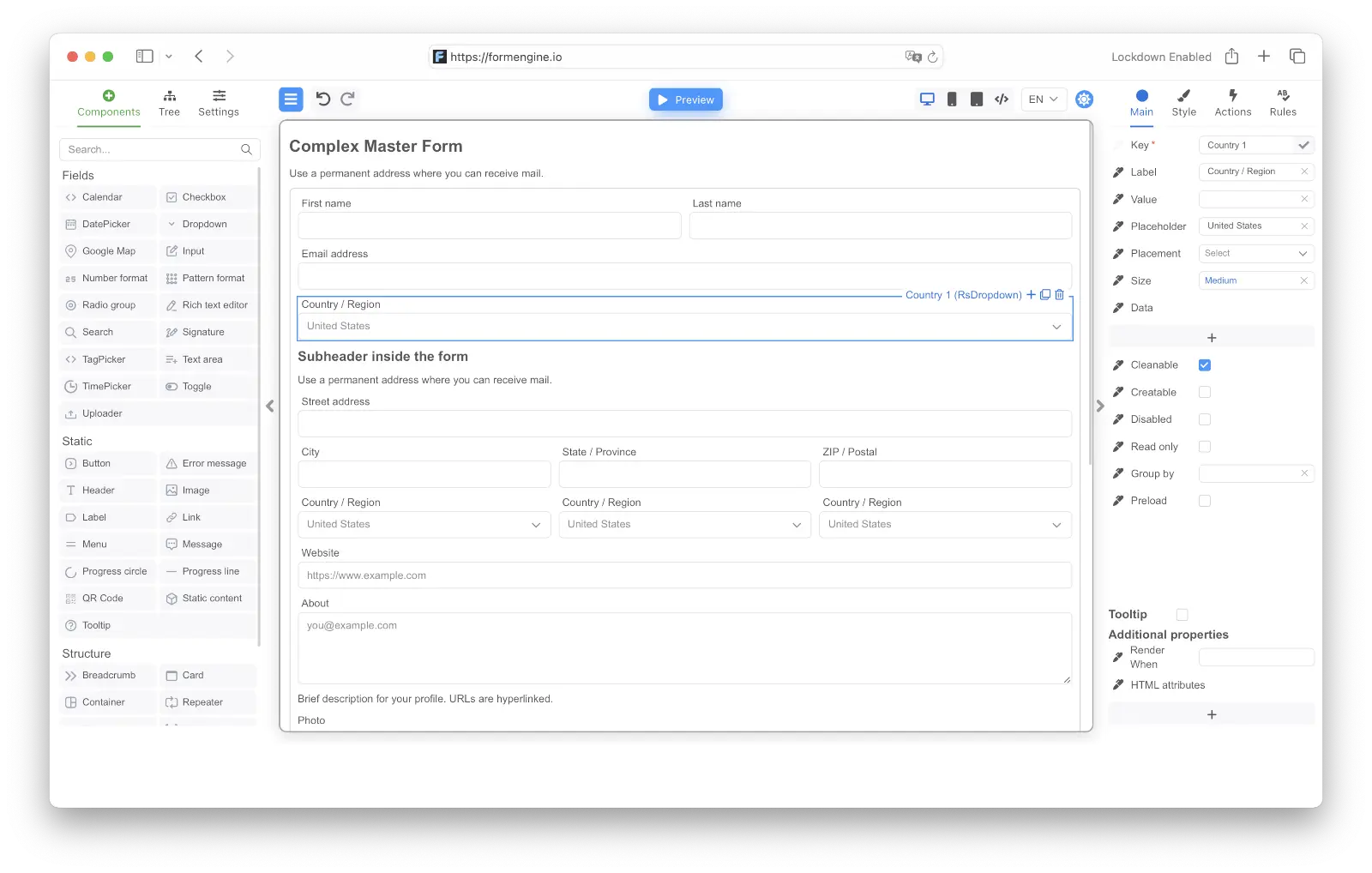
- Optional visual drag-and-drop editor (FormEngine Designer)
- Schema is portable across teams, environments, and products
Feature comparison
| Feature | Formik | FormEngine |
|---|---|---|
| Core model | Code-first (JSX + hooks) | JSON-first (schema → render) |
| Form definition lives in | React components | JSON schema |
| Deploy to change a field | Yes — code change required | No — update schema only |
| Visual drag-and-drop editor | Not available | Native with Designer |
| Conditional field logic | Manual: values + JSX conditionals | Declarative in schema |
| Multi-step / wizard forms | Manual with state management | Built-in Wizard component |
| Validation approach | Yup / custom functions | Schema-driven + Zod support |
| TypeScript support | Supported | Supported |
| Bundle size (gzipped) | ~12–14 KB | ~245 KB default (login form); ~190 KB with MUI |
| UI library flexibility | Works with any UI | Modular: MUI, Mantine, custom |
| Next.js / Remix support | Yes | Yes — see integrations |
| Open source license | MIT | MIT (Core) |
| Commercial version | No | Yes — Designer pricing |
| Active development | Low activity in 2025–2026 | Active, regular releases |
| Non-developer form editing | Not supported | Supported via Designer |
| Schema portability across teams | Not built-in | Native pattern |
| Learning curve | Low–Medium | Medium: JSON schema model |
Bundle size context
Formik is lighter than FormEngine in raw bundle size (~12–14 KB gzipped). FormEngine is larger because it includes a full runtime renderer and component system. When using an external UI library like Material UI with FormEngine, the default component layer is replaced and the bundle becomes more competitive. See the full data: Bundle Size Comparison of Form Libraries. If minimizing JavaScript payload is your top priority and forms are fully code-driven, Formik (or React Hook Form) remains the lighter option.When Formik is enough
- Your forms are stable with infrequent changes
- Form ownership is fully with frontend developers
- You are maintaining an existing Formik codebase without pressure to migrate
- You do not need visual authoring or runtime schema portability
- Your team is comfortable with Yup-based validation
When FormEngine is a better fit
- Forms change often and each change requires a code deployment
- Non-technical users need to create or edit forms
- You are building a product that lets customers configure forms
- You need schema portability across teams or environments
- You want an actively maintained library with a public roadmap
- You need one system for both code-driven and visually authored forms
Incremental migration path
You do not need to rewrite all Formik forms at once. Hybrid coexistence is the normal path:- Keep stable Formik forms as-is. Do not migrate what is working and not changing.
- Identify forms with the highest change frequency or cross-team coordination cost.
- Move those forms to a JSON schema and render them with FormEngine Core.
- Add FormEngine Designer where non-developers need editing access.
- Migrate remaining forms over time as you update features.
FAQ
Is FormEngine a one-line drop-in replacement for Formik?
No. The libraries have different architectures. Formik manages form state in JSX; FormEngine renders from a JSON schema. Migration is incremental: move forms one by one, starting with the highest-change ones.Can Formik and FormEngine coexist in the same codebase?
Yes. They are independent libraries with no conflicts. Many teams run Formik for stable code-owned forms and FormEngine for dynamic or visually authored forms in the same project.Should I migrate my Formik codebase in 2026?
It depends on your situation. If your Formik forms are stable, working, and not changing — there is no urgent reason to migrate. If you are starting a new project, or if your forms change frequently, or if you need visual editing, FormEngine is worth evaluating.Does FormEngine support Yup validation like Formik?
FormEngine has its own built-in validation system. It also supports Zod for type-safe validation. Yup integration requires a custom adapter, but the built-in system covers most use cases.What is the main advantage of FormEngine over Formik for SaaS products?
For SaaS products, the main advantage is the ability to let customers configure their own forms through an embedded visual builder, without writing code. Formik does not support this pattern natively.Is Formik still maintained?
Formik is stable but in a low-activity maintenance phase as of 2026. The core API is unlikely to change, but new features and active bug triaging are limited. For a long-term library dependency, this is worth considering.Does FormEngine work with React 18 and React 19?
Yes. FormEngine supports current React versions. Check the release notes for the latest peer dependency requirements.Is FormEngine free?
FormEngine Core is MIT-licensed and free for commercial use. FormEngine Designer (the visual drag-and-drop builder) has a commercial license for production use. See pricing.See also
- Migration guide: Formik → FormEngine — step-by-step with before/after code
- Workflow approval forms — multi-step approval with role-based fields
- Inspection and data collection forms — Repeater, conditional follow-ups, signature capture
- Form Library Comparisons — broader landscape overview
- Getting Started — try FormEngine
- Bundle Size Comparison — benchmark data
- GitHub repository
- @react-form-builder/core on npm
- Designer pricing
- Online form builder demo