

The core architectural difference
React Hook Form: register in code
React Hook Form works by registering input fields inside React components using hooks. The form structure lives in your JSX. Changing a field means changing code and deploying.- Field definitions are part of your component tree
- Validation rules are declared in JSX or via a schema resolver (Zod, Yup)
- Strong ergonomics for forms that are tightly coupled to their UI
- No runtime schema: the form is defined at compile time
FormEngine: render from schema
FormEngine separates the form definition (a JSON object) from the renderer (a React component). The schema can be loaded from an API, a database, or a static file. Changing a field means changing the schema — no code deployment required.- Form structure lives in a JSON config, not in JSX
- Validation, conditional logic, and actions are all schema-driven
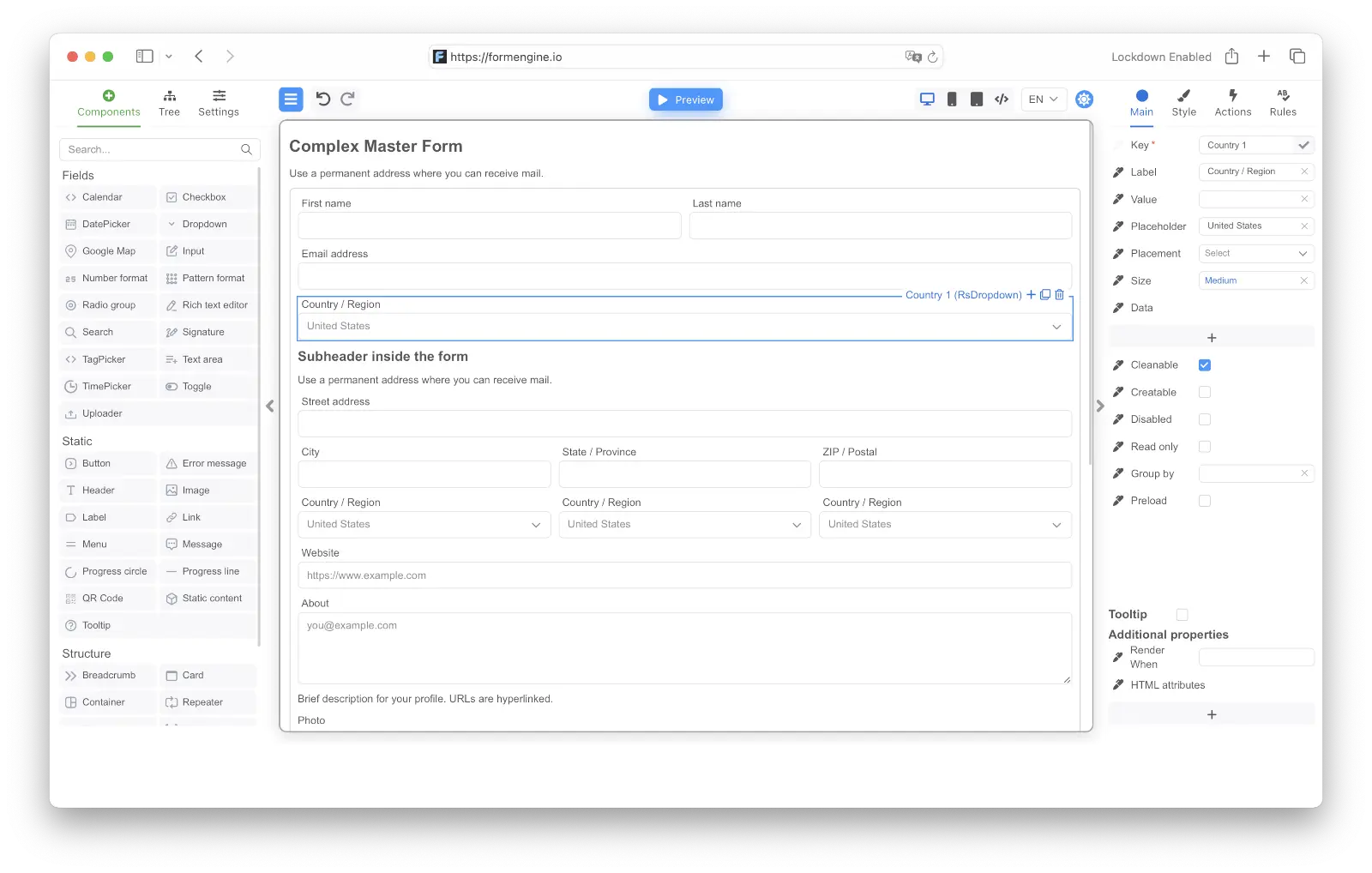
- Optional visual editor (FormEngine Designer) lets non-developers modify forms
- Schema is portable: the same definition works across environments and teams
Feature comparison
| Feature | React Hook Form | FormEngine |
|---|---|---|
| Core model | Code-first (hooks + JSX) | JSON-first (schema → render) |
| Form definition lives in | React components | JSON schema |
| Deploy to change a field | Yes — code change required | No — update schema only |
| Visual drag-and-drop editor | Not available | Native with Designer |
| Conditional field logic | Manual: watch() + conditionals | Declarative in schema |
| Multi-step / wizard forms | Manual with state management | Built-in Wizard component |
| Validation approach | Hook-based (register + resolver) | Schema-driven + Zod support |
| TypeScript support | Excellent (full inference) | Supported |
| Bundle size (default UI, gzipped) | ~9–10 KB | ~245 KB with default UI; ~190 KB with MUI |
| UI library flexibility | Works with any UI | Modular: swap to MUI, Mantine, custom |
| Next.js / Remix support | Yes | Yes — see integrations |
| Open source license | MIT | MIT (Core) |
| Commercial version | No | Yes — Designer pricing |
| Schema portability across teams | Not built-in | Native pattern |
| Non-developer form editing | Not supported | Supported via Designer |
| Learning curve | Low for React devs | Medium: JSON schema model |
Bundle size context
React Hook Form is exceptionally lightweight (~9–10 KB gzipped). FormEngine is larger because it ships a full runtime renderer on top of a UI component layer. When FormEngine is integrated with an external UI library like Material UI, its default React Suite components are removed from the bundle. In benchmarks, FormEngine Core with Material UI reaches ~190 KB gzipped for a login form — competitive with other JSON-schema-driven libraries. See the full methodology: Bundle Size Comparison of Form Libraries. If raw bundle size is your primary constraint and your forms are fully code-driven, React Hook Form remains the lighter choice.When React Hook Form is enough
- Your forms are stable and change infrequently
- Form ownership is fully with frontend developers
- You do not need runtime schema portability or visual editing
- You are optimizing for minimal JavaScript payload
- You are building a small to medium project with no cross-team form governance
When FormEngine is a better fit
- Forms change often and deploying for every field change is costly
- Non-technical users (ops, product, designers) need to modify forms
- You are building a SaaS product that lets customers configure their own forms
- You need one system for both code-driven and visually authored forms
- Multiple teams share form definitions across products or environments
- You need conditional logic, multi-step flows, and computed fields without custom wiring
Incremental migration path
You do not need to replace all React Hook Form forms at once. A hybrid approach is the practical migration pattern:- Keep existing React Hook Form flows where they are stable and developer-owned.
- Identify the forms with the highest change frequency or cross-team coordination cost.
- Move those forms to a JSON schema and render them with FormEngine Core.
- Add FormEngine Designer only for the forms that non-developers need to edit.
FAQ
Is FormEngine a drop-in replacement for React Hook Form?
No. The two libraries have fundamentally different architectures. React Hook Form registers fields in JSX; FormEngine renders from a JSON schema. Migration is form-by-form, not a one-line swap. Start with the highest-change forms and keep stable RHF forms in place.Can React Hook Form and FormEngine coexist in the same codebase?
Yes. They are independent libraries with no conflicts. A hybrid codebase — RHF for stable, developer-owned forms, FormEngine for dynamic or visually authored ones — is a common and practical migration path.Which is faster to learn for a React developer?
React Hook Form is faster to learn for someone already comfortable with React hooks. FormEngine requires understanding its JSON schema format, but this pays off quickly when forms need to be shared across teams or edited by non-developers.Does FormEngine support Zod validation like React Hook Form?
Yes. FormEngine supports Zod for schema-level validation. You can also use its built-in validation system without adding Zod as a dependency.What is the main advantage of FormEngine over React Hook Form at scale?
The main advantage is operational leverage: when a form needs to change, you update a JSON schema rather than writing and deploying code. At scale — many forms, frequent changes, multiple teams — this reduces the engineering cost significantly.Does React Hook Form support a visual form builder?
React Hook Form does not include a visual form builder. Third-party builders that output React Hook Form code exist, but they are not part of the core library. FormEngine includes a native visual designer in the same ecosystem.Which library should I use for a Next.js project?
Both work with Next.js. FormEngine has a dedicated Next.js integration guide. If your forms are simple and fully code-owned, React Hook Form is the lighter choice. If you need dynamic forms from an API or visual editing, FormEngine is the better fit.Is FormEngine free?
FormEngine Core is MIT-licensed and free. FormEngine Designer (the visual drag-and-drop builder) has a commercial license. See pricing for details.See also
- Migration guide: React Hook Form → FormEngine — step-by-step with before/after code
- Workflow approval forms — multi-step approval with role-based fields
- Customer onboarding forms — plan-tiered onboarding with CRM pre-fill
- Form Library Comparisons — broader landscape overview
- Getting Started — try FormEngine
- Bundle Size Comparison — benchmark data
- GitHub repository
- @react-form-builder/core on npm
- Designer pricing
- Online form builder demo